

E-learning content creation programme
In September 2009 the Association of Learning Providers invited bids for a pilot e-learning content creation (ECC) programme. Capital funding for this project was provided by the Skills Funding Agency and the Department for Business, Innovation and Skills.
The purpose of the pilot was to examine how investment in high quality e-learning content and programme development could significantly improve the cost effectiveness of delivery within the skills sector.
The e-learning materials developed within the pilot were to be placed within the JorumOpen resource repository and made freely accessible for interested training organisations.
Post-16 e-learning teacher training materials
Nuneaton Training Centre (NTC), in partnership with Hibernia College and Learning at Work, was awarded a £400,000 project to develop post-16 teacher training e-learning materials by the end of 2010. (I managed the project for NTC.)
The e-lessons were designed to provide professional knowledge and understanding for units of teacher training qualifications:
- Preparing to Teach in the Lifelong Learning Sector (PTLLS)
- Certificate in Teaching in the Lifelong Learning Sector (CTLLS)
- Diploma in Teaching in the Lifelong Learning Sector (DTLLS)
- Diploma in Teaching English (Literacy) in the Lifelong Learning Sector.
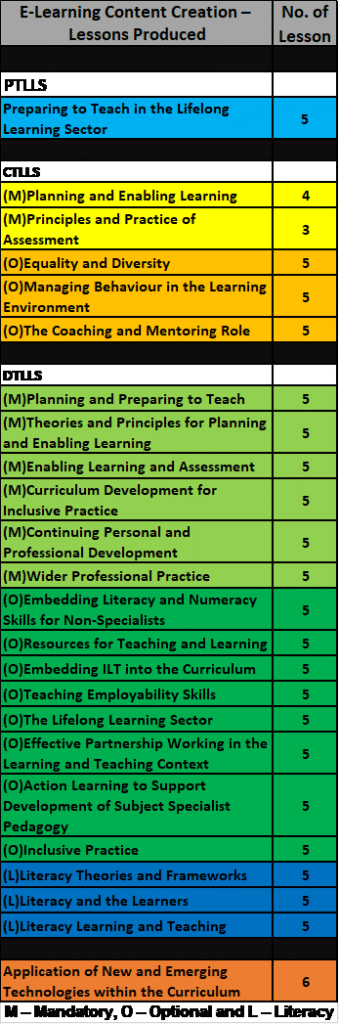
The project created almost 40 hours of blended e-learning material (117 lessons) covering post-16 teaching in the lifelong learning sector and literacy underpinning knowledge that was aligned to national standards.
Each unit comprised individual lessons (usually five), all of which were prepared by practising professionals from colleges, learning providers and universities. Lesson commentaries were recorded by authors to provide engaging studio quality lectures.
Lessons were designed to reflect a range of learning styles and included case studies, interactive quizzes and opportunities to relate the topics to learners’ own environments and experiences.
Project objectives
The objective was to support people training to teach or to work in any teaching-related role in the lifelong learning sector. Practising teachers, trainers in industry, tutors, instructors, lecturers, assessors and those intending to teach would benefit from the materials, especially those working in further, adult and community education, higher education, work-based learning or the voluntary sector.
Learning organisations could use the e-lessons within a blended approach that was tailored to their learners’ needs; this could include contextualisation for learners in the workplace, in line with their industry or subject specialisms.
The learner would have access to on-demand lessons that they could review at their own convenience; this could re-enforce learning and enable face-to-face tuition to build a strong base of knowledge and therefore increase its effectiveness.
As learners gained underpinning knowledge independently, it would be possible for them to complete their qualification within a reduced timeframe.
Lesson development process
Authors were selected for each unit based on their knowledge of the subject area, with an equally experienced reviewer appointed to provide a second check as part of the quality assurance process.
Authors ensured that they knew the standards for their allocated unit and would prepare five lessons of approximately 20 slides each. Quality reviewers considered compliance with national standards, and the cohesiveness and flow of the lessons. My role as NTC project manager was to review and edit content to ensured currency of material and that lessons had a work-based learning focus. Feedback was considered by the author who then amended the lessons.
The revised version was passed to Hibernia College for review to apply the project’s style and align the PowerPoint and script. Authors then recorded and uploaded the narrated lesson – this made lessons authentic and allowed the project to contain a variety of voices.
The technical team at Hibernia College completed the unit, including any pictures, video clips or interactive quizzes suggested by the authors (subject to clearance).
Finally, Hibernia College staff uploaded the final material into the open access repository and make it available for interested stakeholders to use for their own teaching.
Project management and developmental editing
I joined NTC after the project had begun. Original staff members from each partner had left and delivery was running behind schedule. With a finite and challenging timeframe, I took control, gained awareness of every aspect of the project and took decisive action.
I assessed the development plan and identified areas where delivery was progressing, as well as where it was slow and needed a new approach. Next, I introduced processes and author/reviewer contracts, built relationships and communicated regularly, supporting authors and reviewers through the lesson creation process.
I reviewed all project lessons to provide quality assurance checks and offered detailed developmental editing support that included preparing a report and a series of queries for each author. Following external feedback, I added a work-based training dimension where material was too classroom, college or even university based. Examples included adding references to learning providers, apprenticeships, teaching/assessment patterns, e-portfolios and vocational scenarios.
A challenge was the significant turnover of authors – 70 were approached for the 24 units with 41 appointed at different stages – as work commitments or redundancy required them to drop out. Having reviewed their contributions, I asked several authors to stop work and recruited replacements to ensure that lessons were of sufficient quality and delivered on time.
Tim managed a complex and challenging project for NTC which achieved its objectives and targets on time and led to further work for the organisation. Tim’s experience, knowledge and skills had a positive impact on NTC and I would highly recommend him for any relevant consultancy work or employment.
Julie Sizer, formerly Chief Executive, NTC Training Limited

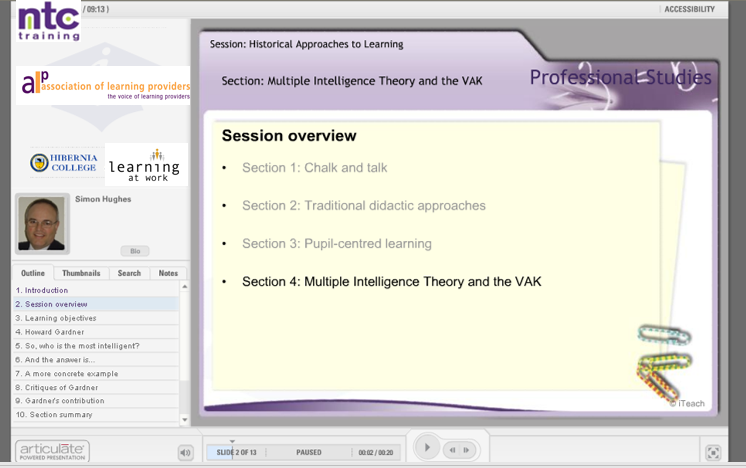
This PTLLS PowerPoint lesson was subsequently narrated by the author, finalised by Hibernia College and uploaded.
Successful partnership project
The NTC–Hibernia College partnership was effective in managing the process, as I appointed authors, supported content development and managed finances. Hibernia College staff outlined layout, and guided authors through the course development process and audio recording. The blend of this knowledge and expertise, together with a strong working relationship, was the reason for the project’s success.
I worked with Tim on the E-Enabled Teacher Training project where he demonstrated an excellent capacity for managing complex programmes. He successfully managed the development of 117 online lessons to tight schedules to ensure the project was completed within the agreed timeframe.
Tim is a highly organised, intelligent person with very strong interpersonal skills. He sees tasks through to completion in a timely manner. He has a very professional attitude and excellent project management skills. Tim is a pleasure to work with and I would highly recommend him!
Deirdre McGrath, formerly Knowledge Officer, Hibernia College
I made the formal end of project presentation to the Skills Funding Agency and Department for Business, Innovation and Skills. I also gave the product launch presentation to interested stakeholders.
This was a challenging project, but one that was very satisfying, as the final product was delivered on time and in budget, with a high level of appreciation for the completed e-learning materials.
Writing: NTC teacher training course materials
Having completed the ECC project, I continued to work with NTC (on a self-employed basis) using the e-lessons as a foundation for developing full PTLLS and CTLLS courses. I scoped course development requirements, mapped e-lessons against awarding body criteria and put in place delivery plans.

After receiving Moodle Administrator training, I designed, wrote and set up courses within the VLE and helped NTC to gain awarding body approval with City and Guilds to deliver teacher training for the first time, as well as launched and supported the pilot courses.
To provide clear information for learners, I wrote introductory guidance documents for each unit together with an FAQs page. I summarised the content of each lesson and prepared activities and assignments (in line with City and Guilds requirements) to provide the infrastructure for learners to use alongside the e-lessons and with support from their tutor.