

Projects
Between December 2013 and March 2021 I managed three European Commission funded partnership research projects for Coventry University. These were:
Project management
I was a member of each project’s management team that planned, set tone and direction, implemented processes and adapted to change. I monitored progress against detailed descriptions of work/activity, oversaw the quality of written deliverables/reports and the development of policy recommendations/best practice guides.
My relationships with partners were important, as I was able to guide them through the complexity of rules and regulations, offer support, influence activity, identify risks and implement solutions. I kept records of partner expenditure to manage project budgets, agreed their financial statements (on the EC participant portal) and authorised payments to them.
I co-organised events – conferences, workshops, seminars, policy briefings – across Europe, including hosting, speaking, and participating in panel sessions. I had financial oversight to ensure that events worked within budget and that speakers and suppliers were paid.
As the central point for each project, I had an overview of work undertaken, lessons learnt and best practice, and was able to cross-reference activities, draw out findings and shape project conclusions.
I wrote technical project reports and public-facing summaries for the European Commission detailing activity, results and recommendations (that are available on CORDIS – RICHES | Europeana Space | REACH).
Each European Commission project officer commended the quality of my project management.
I have known Tim from our collaboration within the RICHES project and have formed a very high opinion of him.
Within the RICHES consortium Tim turned out to be the key-figure, without whom the outcome of this successful venture would have been likely very different. His outstanding time-management and communication skills, ability to report precisely and efficiently, leadership skills, overall cheerful personality and an inspiring positive attitude made him an irreplaceable asset of the project.
If I ever have to lead a large research consortium, Tim will be the first person whom I will ask to join as project manager.
Professor Karol Borowiecki, University of Southern Denmark
RICHES
Renewal, Innovation and Change: Heritage and European Society (RICHES) December 2013–May 2016. Project value: €3 million.
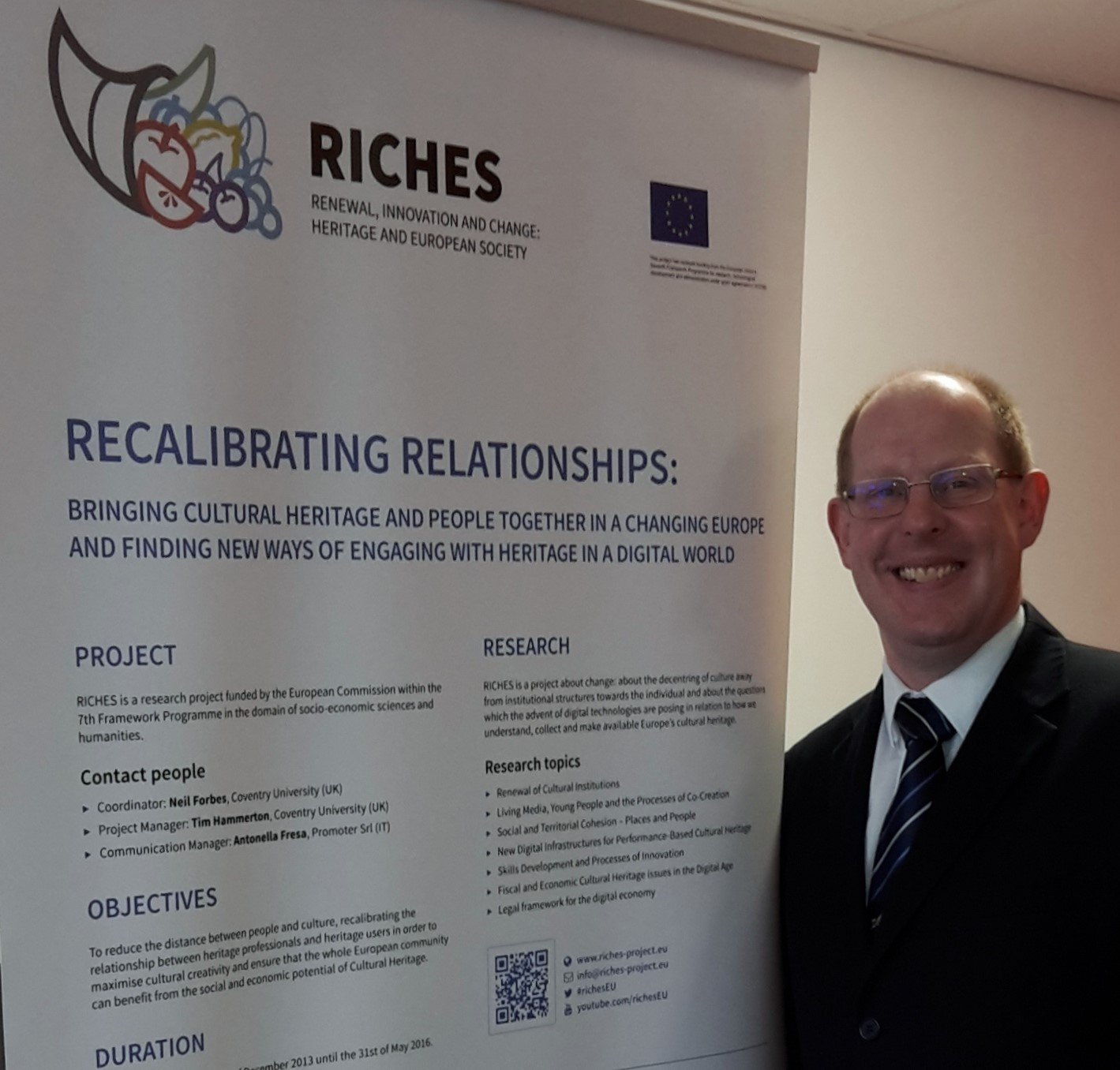
The objective of the RICHES project was to recalibrate relationships between Europe’s people and their cultural heritage as digital technologies were beginning to permeate society, and to challenge people and institutions to reconsider their traditional practices.
The European Commission’s Seventh Framework Programme (FP7) funding strand covered socio-economic sciences and humanities. RICHES was a project that considered the effects of new and emerging digital technologies on society.
Themes included transformation and change in heritage, identity, place, social and territorial cohesion, co-creation, economic heritage and interactive (museum) heritage.
The project included 10 partners that were from the United Kingdom, Germany, Italy, Spain, Netherlands, Denmark and Turkey.
At the final public policy seminar in Brussels, the European Commission’s project officer pronounced that RICHES had been one of the best projects that he had seen.
Editing: project reports and deliverables
Each project followed a detailed description of work/activity that outlined tasks, areas of partner collaboration and the titles of deliverables to describe activities and share findings.
Projects submitted between 21 and 32 deliverables – each ranging between 5,000 and 70,000 words, with an average of 21,500. Some were written by a single partner and others were collaborative, with case studies and content that needed a conclusion to draw arguments together.
I was responsible for quality assurance and partners’ completion of deliverables. I liaised regularly to understand progress and put support and solutions in place when tasks fell behind schedule – including bringing in additional contributors – to ensure that work was completed. Other editing tasks included work on brochures, newsletters and webpages for each project to provide clear messages.
I worked on multiple iterations of deliverables to get them to the necessary standard, seeing at least two versions of many and up to four or five for those where authors needed more support. This included providing initial developmental editing feedback and raising queries to help improve the content, structure and flow.
As most authors were not writing in their first language, many deliverables needed work to improve the level of English – that could involve structural copyediting or a substantial line-by-line edit – as well as work to align varied writing styles to fit with the project’s approach.
The European Commission regularly commented on the quality of the projects’ deliverables.
A former project partner subsequently asked me to copyedit multi-partner written project books detailing Volterra’s years as Tuscan City of Culture and the PAGODE – Europeana China project.
Europeana Space
Spaces of possibility for the creative re-use of Europeana’s content (Europeana Space) February 2014–January 2017. Project value: €5 million.
The project management has been very well performed. A consortium of 29 partners with a diversity of disciplines and interest and reaching these positive results, could only be achieved through the support and coordination of an excellent project manager, project coordinator and
technical project coordinator.The project manager is endorsed for future European project management.
European Commission technical review report
The Europeana Space project was designed to increase and enhance the creative industries’ use of Europeana’s repository of digitised cultural heritage content by delivering a range of resources to support their engagement.
The use of Europeana by the creative industries was limited by the intellectual property rights (IPR) status of content and the need for business models demonstrating the potential for exploitation of available content.
To address these problems the project brought together expertise from European creative industries, technology-based enterprises, the cultural heritage sector and higher education.
The project was funded through the European Commission’s Competitiveness and Innovation Framework programme. As a Best Practice Network, partners creatively re-used content from Europeana (and other digitised cultural heritage sources) and produced guidance for others to follow.
The project included 29 partners that were from the United Kingdom, Italy, Belgium, Greece, Netherlands, Germany, Portugal, France, Ireland, Estonia, Lithuania, Cyprus and Czech Republic.
At the final European Commission technical review, Europeana Space was considered ‘Excellent – having exceeded expectations’; this was significant for a project with 29 very different partners and multiple ambitious strands of work.
Partner perspective
I’ve worked with Tim over a period of three years as one of the consortium members on the E-Space programme he managed. Throughout this period, Tim demonstrated his abilities as an exceptional Programme Manager, skilfully balancing the competing demands, timescales and personalities of 30 major partners and multiple work packages, and overseeing teams from many different sectors and countries – an extremely difficult task that Tim managed to deliver with a smile and whilst balancing other, equally-demanding programmes alongside this one.
E-Space was our first EU-funded consortium project, and Tim was indispensable in helping us navigate through some complex processes and requirements – converting his detailed knowledge into clear explanations, firm goals and deliverable action plans. I saw him take a similar approach with all 30 partners, adapting to the specific experience and needs of each one, in order to guide them through the various stages of the process and deliver both on time and on budget.
Furthermore, Tim’s grasp of both the strategic overview and operational detail enabled him to encourage each consortium member to deliver above and beyond what was originally envisaged, as well as identifying and encouraging new linkages between different elements of the programme. This in turn resulted in a stronger, more cohesive programme and set of overall outcomes.
Tim was a persistent driving force throughout the programme, always friendly and willing to assist. That the programme was judged ‘Excellent’ speaks for itself and the quality of work Tim directed. We really hope to be able to work with such a talented programme manager again soon, and would highly recommend Tim to others.
Simon Cronshaw, Co-founder, REMIX Summits
Writing content
Having sat at the heart of each project and overseen completion of all deliverables, I was best-placed to draw conclusions on results and recommendations, and share them. I therefore wrote all deliverables and technical reports that summarised the work of the projects, as well as public-facing summaries. The content of my reports was recognised by the European Commission, due to the comprehensive overview of activity.
Where partner authors were struggling to present their findings or had left the project before finishing their work, I wrote additional content, linking material and/or introductory/concluding sections to ensure that deliverables met their objectives. I also co-authored a RICHES European Commission policy brief on European identity and the Europeana Space games case study for a project book.
REACH
RE-designing Access to Cultural Heritage (REACH) November 2017–February 2021. Project value €1.5 million.
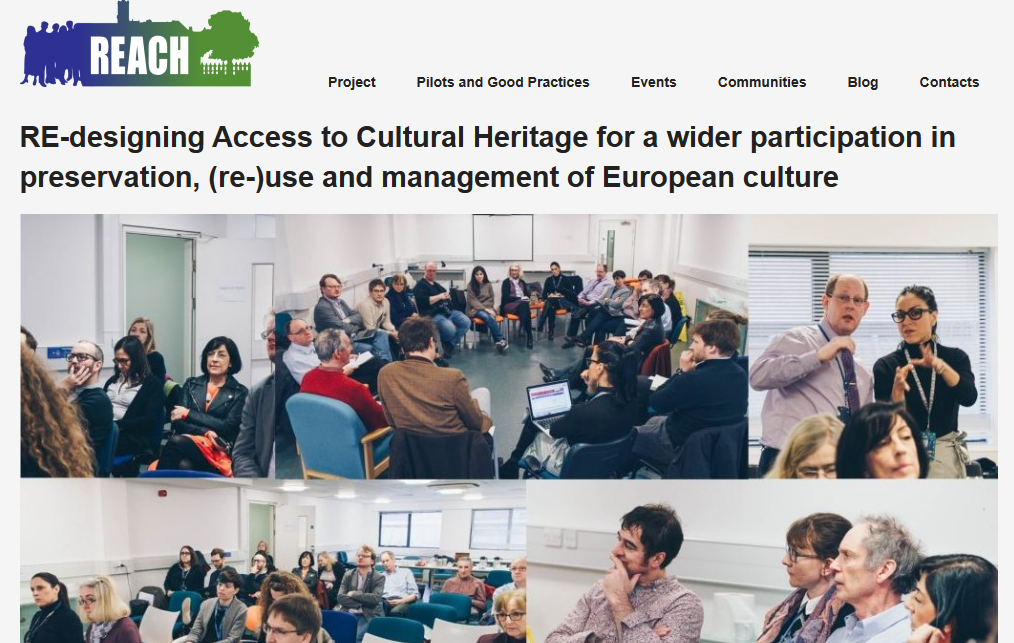
The REACH project aimed to unlock the potential of people, communities and institutions to engage within culture and cultural heritage. The project’s twofold objective was to establish a social platform that would:
- map and provide analysis of research results from previous programmes, identify current and emerging research trends and offer authoritative new knowledge of the cultural heritage field to the European Commission and policy makers
- expand knowledge of complementary research domains and new participatory research methodologies, generate opportunities for cooperation and offer pathways to wider user engagement with research outputs.
The project was funded as a Coordination and Support Action through the European Commission’s Horizon 2020 programme.